
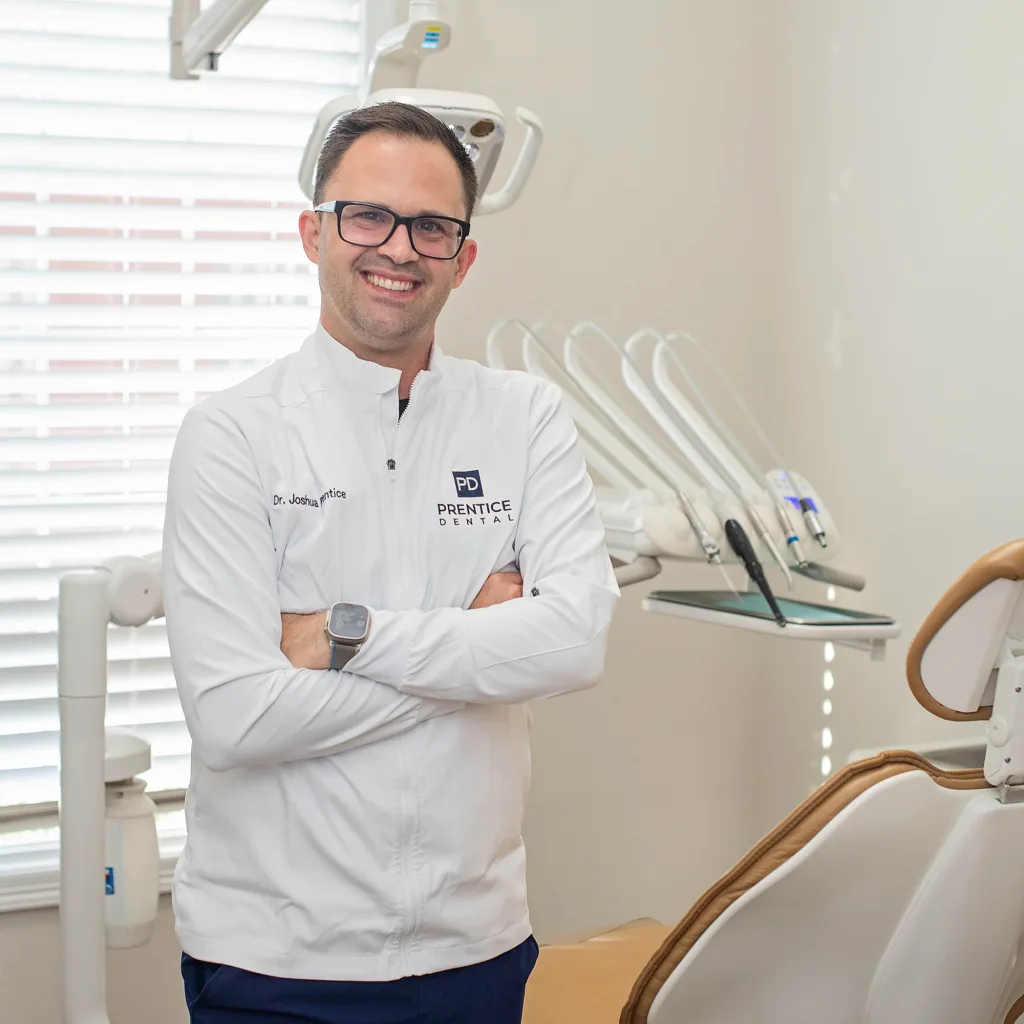
Joshua Prentice, DDS
When you sit in the dental chair, you generally expect a few familiar commands: “lean back,” “open wide,” maybe even “turn toward me.” But at Prentice Dental in Flower Mound, the most important part of your exam happens before you ever open your mouth.
As Dr. Joshua Prentice explains, everything starts with a conversation. And there’s a very good reason for it. After all, for many patients, dentistry has traditionally been reactive — you break a tooth, the dentist fixes it; you get a cavity, it gets filled. But that approach rarely answers the bigger question: why did the tooth break in the first place?
And why, despite your best efforts, do your specialized crowns keep chipping?
The answer rarely lies in the tooth itself. It lies in a complex system of muscles, joints, airway health, and medical history that most dental exams overlook. This is the difference between “fixing teeth” and comprehensive treatment planning — and it is the foundation of the care provided at Prentice Dental.
The Art of Listening: The First Clue
By having a conversation with a dentist who listens intently to your medical and dental history, you’ll notice that they are able to gather the “clues” necessary to solve the mystery of your oral health. No, they aren’t just looking for cavities. They are looking for the root cause of instability in your system.
“I train my team to listen for the answers that aren’t on the chart,” Dr. Prentice said. “We don’t just want to know if you floss. We want to know if you wake up with headaches. We want to know if your partner says you snore. We want to know about your diet, your stress, and your medical history.”
This isn’t just small talk, Dr. Prentice added. It is diagnostic data. After all, the human body is an interconnected machine. A patient listing “acid reflux” on their medical history form isn’t just telling their doctor about their stomach. They are warning them about potential chemical erosion on their enamel. A patient mentioning “chronic fatigue” may not be tired — they may be suffering from Sleep Disordered Breathing or undiagnosed apnea, where the structure of the jaw is physically blocking their airway at night.
By listening intently to your medical and dental history, Prentice Dental gathers the “clues” necessary to solve the mystery of your oral health.
“We aren’t just looking for cavities,” Dr. Prentice said. “We are looking for the root cause of instability in your system.”
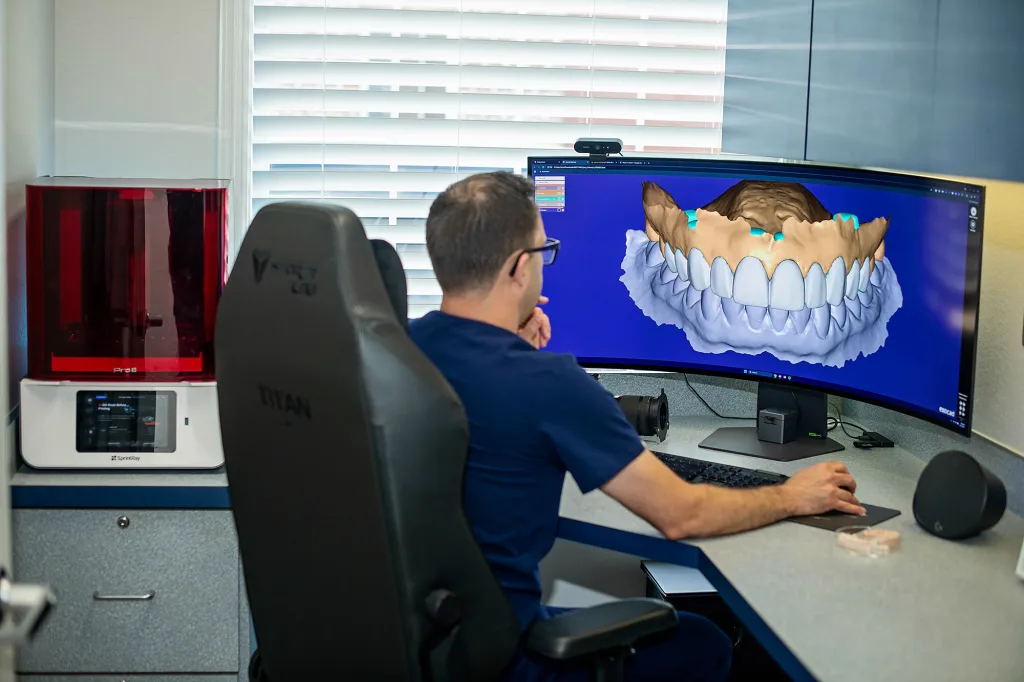
The Visual Analysis: Reading the Face
Before looking at the teeth, Dr. Prentice and his team look at the person.
“Form follows function,” Dr. Prentice explains. “If I see a patient with enlarged jaw muscles or a face that appears shorter in the lower third, I immediately suspect a biting or chewing problem.”
Your face tells a story. Asymmetry in the smile, worn-down edges on the front teeth, or gum recession often signal that your bite is unbalanced. When your teeth don’t fit together harmoniously with your jaw joints (TMJ) and muscles, the system breaks down.
Teeth grind down, porcelain cracks, and muscles spasm (leading to tension headaches).
Traditional dentistry might patch the cracked tooth. Comprehensive dentistry asks: How do we adjust the system so this doesn’t break again?
The “Kois Difference:” What Does It Mean for You?
To treat these complex issues — TMJ disorders, sleep-disordered breathing, and bite dysfunction — Dr. Prentice sought training far beyond standard dental school requirements. In fact, he is a Kois Center graduate with honors. You may not have heard of the Kois Center, but in the dental world, it is synonymous with excellence. Based in Seattle, it is an advanced, evidence-based curriculum that functions like the “special forces” training of restorative dentistry. It relies on rigorous scientific data, not just clinical opinion.
Graduating with honors is a distinction held by fewer than 5% of all Kois-trained graduates. It means Dr. Prentice hasn’t just attended the courses; he has mastered a curriculum focused on the engineering of the mouth. Think of it this way: A general dentist is like a mechanic who can replace a tire. A Kois graduate is like an automotive engineer who analyzes the suspension, alignment, and road conditions to ensure the tires do not wear out unevenly.
This training allows Prentice Dental to offer:
- Predictability: Treatments that last because they are engineered to handle your specific bite forces.
- Risk Assessment: Identifying if you “are high risk for gum disease, decay, or biomechanical failure before it becomes a painful emergency.
- Comprehensive Care: A roadmap for your health that looks five, 10, and 20 years into the future.
Your Invitation to a Higher Standard of Care
“I want patients to know that they are allowed to ask questions,” Dr. Prentice said. “If you are suffering from jaw pain, if you hate the way your teeth look, or if you are just tired of constant dental repairs, you deserve a comprehensive plan.”
Whether you are seeking a cosmetic transformation or a solution for sleep apnea and chewing problems, the process starts the same way at Prentice Dental:
They listen. They observe. And they plan.
Stop guessing about your dental health. Come to Prentice Dental for a free consultation. Experience what it feels like to have a doctor who looks at the whole picture — your history, your face, and your future — to build a smile that is unique, personalized, and built to last.
“I want patients to know that they are allowed to ask questions. If you are suffering from jaw pain, if you hate the way your teeth look, or if you are just tired of constant dental repairs, you deserve a comprehensive plan.”